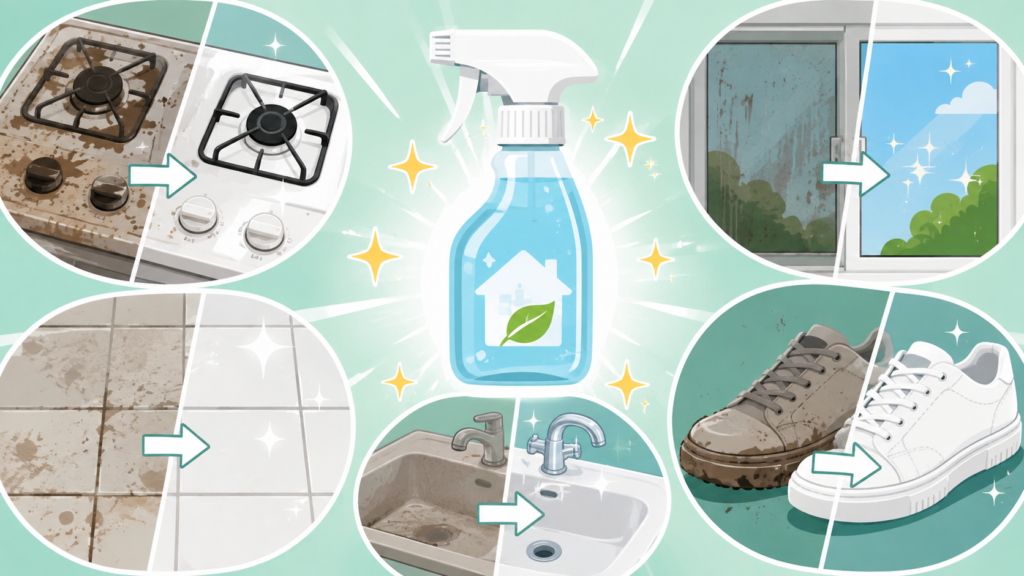
This homemade product cleans almost anything and prepares in minutes
Anúncios
A homemade all-purpose cleaner can solve many everyday tasks with simple ingredients.
Mixing water, white vinegar, and a small amount of detergent works on many washable surfaces, but should not be used on natural stone, unsealed wood, or electronics.
SEE THE FULL RECIPELEARN HOW TO PREPARE ITSEE WHERE YOU SHOULDN'T USE ITA home cleaning recipe is only really useful when you know what each ingredient does and where it can be applied. For an all-purpose bottle, a practical combination is warm water, white vinegar, and a small amount of neutral dish detergent. Water serves as a base, detergent helps loosen grease, and vinegar provides acidity to loosen mineral marks and soap residue.
To prepare around 750 milliliters use 500 ml of warm water, 250 ml of white vinegar and a teaspoon of neutral liquid detergent. Place the water first, add the vinegar and add the detergent at the end. Mix with gentle movements so as not to fill the foam bottle. Label the container and keep it out of the reach of children and pets.
Anúncios
The mixture works well on enameled tiles, glass, some washable plastics, synthetic sinks, and lightly greasy surfaces. It can also help with shower doors and water stains. However, “multius” does not mean “for absolutely all”. Vinegar can attack natural stone, certain sealants, and sensitive finishes.
The most important care is not to mix this recipe with chlorine or bleach. Acids can react with products containing hypochlorite and release dangerous gases. Also do not combine different cleaners because it seems that they will clean more. If you have already used another chemical, rinse the surface and ventilate before changing products.
For best results, work in sections. Apply a small amount to the cloth or a compatible surface, leave it on for a minute or two when there is light grease, and remove with a damp cloth. Then dry. Controlled cleaning is usually more effective than saturating the surface with liquid.
- 500 ml of warm water.
- 250 ml of white vinegar.
- 1 teaspoon neutral detergent.
- Clean and labeled bottle.
- Never mix with bleach, bleach or unfamiliar cleaners.
Why this mixture can clean so many surfaces
Detergent contains surfactants that help separate grease and dirt. Vinegar can dissolve some mineral deposits and soap residue. At moderate dilution, both cover many household maintenance tasks without the need to use a different product in each room.
That doesn't make the mixture a high-level disinfectant. Cleaning and disinfecting are different objectives. When a surface requires disinfection for a health reason, use a product designed and labeled for that purpose, respecting its contact time.
SEE THE FULL RECIPEThe small test that avoids ruining a surface
Before cleaning a large area, test a minimal amount in a discreet area. Wait a few minutes and dry. Observe if it changes shine, color, texture or seal. This step is important on treated metals, countertops, furniture and materials whose composition you do not know.
If no changes occur, continue in sections. On delicate materials it is better to moisten a cloth than spray directly. The goal is to control the amount of moisture and prevent liquid from entering joints, electrical components, or sensitive edges.
SEE THE FULL RECIPEOn glass, if marks appear, reduce the amount of detergent and finish with a clean microfiber cloth. In the bathroom, vinegar can help with soap residue on tiles and glass, but avoid marble, travertine, and other natural stones. In the kitchen, do not spray controls, slots, or electrical connections.
Storage matters too. Prepare moderate amounts and keep the bottle well identified. If you reuse a container, make sure it has never contained chlorine or another reactive chemical. A clear bottle without a label can become a risk when someone else doesn't know what's inside.
If you have sensitive skin, wear gloves. Ventilate small spaces and avoid inhaling aerosol unnecessarily. In case of contact with eyes, rinse with plenty of water. If persistent irritation appears, seek appropriate guidance.
Keep separate cloths for kitchen, bathroom and glass so as not to redistribute grease or debris between surfaces. Wash and dry the cloths after each use. The quality of cleaning depends on both the product and the tool with which you apply it.
Frequently asked questions
Does it clean absolutely everything?
No. It is useful for many washable surfaces, but it is not safe for all materials.
Can I use it on marble?
It is not recommended to use vinegar on natural stone.
Can I mix it with chlorine?
No. That mixture can release dangerous gases.
Is it disinfectant?
It should not be treated as a registered sanitary disinfectant.
Does it work for screens?
No. Electronic devices require products compatible with the manufacturer.
Can I increase the vinegar to clean more?
Not always. A higher concentration increases the risk of damaging finishes.
The second page brings together step by step, care and recommendations.
SEE THE FULL RECIPE